
Smart Lock Installation UK — Everything You Need to Know
I live in a rented flat in London. My front door features a classic British multipoint locking system—the kind where you have to lift the handle before you can turn the key physically. Last month alone, I lost my keys three times. The third time it happened, an emergency locksmith charged me a staggering £120 just for a ten-minute callout.
That was the exact moment I started looking into smart locks.
But here is the catch that most people discover the hard way: the vast majority of smart lock reviews online are tailored for US doors. They assume you have a standard American deadbolt. UK doors are an entirely different beast. We deal with uPVC frames, multi-point hooks, and Euro cylinders.
A smart lock built for a California suburban home will completely fail on a London flat. Either the internal motor won’t have enough torque to turn a stiff, older multi-point latch, or the battery life will completely tank during a freezing UK winter.
To find out what actually works, I spent weeks testing the best options on the market. I installed a few retrofit kits myself, and even called out a local pro to see how professional locksmith services handle the more complex setups. Here is the unfiltered truth about smart lock installation in the UK.
Why UK Renters and Homeowners Need Smart Lock Installation
The Problem with Traditional Keys in 2026
To be honest, physical keys feel incredibly outdated in 2026. They are easy to lose, easy to steal, and shockingly easy for someone to copy without your permission. Worst of all, when they inevitably go missing at 11 PM on a rainy Tuesday, you are entirely at the mercy of emergency locksmith rates.
| Problem | Average Cost (UK) | Time Wasted |
| Emergency Locksmith Callout | £60 – £120 | 1 – 2 Hours |
| Key Replacement / Cutting | £10 – £30 | 1 Hour |
| Full Lock Change (If keys are stolen) | £100 – £200 | Half a Day |
I know these numbers because I actually paid that £120 invoice. Going keyless solves all of this in one go. No more fumbling in the dark, no spare keys hidden under insecure doormats, and zero midnight emergency calls.
However, if you are renting, you can’t just start drilling massive holes into your landlord’s door. You need a solution that keeps your tenancy deposit 100% safe.
UK Door Types — uPVC, Multi-point, & Euro Cylinders
Before spending a single penny on a smart lock, you must identify your exact door setup. If you get this wrong, your new gadget will just sit in the box.
| Door & Lock Type | How to Identify It | Smart Lock Compatibility |
| uPVC / Composite with Multi-point Lock | You must lift the handle upwards to engage the locking bolts. Common in modern flats. | Yes. Needs a heavy-duty motor like the Yale Conexis L2, or a smart handle replacement. |
| Euro Cylinder Lock | The keyhole has a distinct enlarged teardrop shape. Standard across the UK. | Excellent. Highly compatible with clever retrofit brands like Simpled UK. |
| Traditional Nightlatch (Yale Lock) | A rim lock mounted on the inside surface of wooden doors, usually paired with a mortice lock below. | Good. Compatible with specific retrofit smart pods. |
Now, here is a crucial bit of technical reality regarding multi-point doors: while a premium lock like the Yale Conexis L2 replaces your entire handle setup, or a smart kit like Simpled fits over your cylinder, you still have to lift the handle manually to engage the multi-point hooks. The smart lock’s job is simply to throw the final deadbolt or lock the handle mechanism itself. If you forget to lift the handle when closing the door, the door remains unlocked.
🛒 Recommended for uPVC Doors: Check the price of the [Yale Conexis L2 Smart Lock on Amazon]
🔑 Recommended for Renters: Check the price of the [Simpled UK Retrofit Smart Lock]
Furthermore, UK winters can be absolutely brutal on cheap lithium cells. If you choose a smart lock that sits outside or handles heavy motor rotations, always opt for high-quality, cold-resistant batteries and keep a manual override backup key in your bag just in case.
30-Second Verdict
| Installation Type | Average Cost (UK) | Time Required | Skill Level | Best For |
| DIY Retrofit Lock | £0 (Lock cost only) | 10 – 20 mins | Beginner | Renters, no drilling, 100% deposit safe |
| DIY Full Replacement | £0 (Lock cost only) | 30 – 60 mins | Intermediate | Homeowners with standard Euro doors |
| Professional Locksmith | £50 – £150 | 30 – 45 mins | Expert (Hired) | Stiff multi-point locks, peace of mind |
| Smart Lock + Install Bundle | £150 – £300 | 1 – 2 hours | Expert (Hired) | Premium buyers looking for a hassle-free setup |
Can I Install a Smart Lock Myself?
Let’s be completely fair: the short answer is yes. Most modern smart locks are explicitly engineered for DIY installation. Manufacturers are well aware that the average British homeowner or renter doesn’t want to shell out £100 to £150 just to have a locksmith turn a screwdriver for twenty minutes.
But here is the catch, and this is where many people trip up: not all smart locks are created equal. Some are a breeze; others will give you a proper headache.
If your front door features a standard Euro cylinder with an internal thumb-turn, congratulations—you’ve hit the jackpot. Most retrofit smart locks will literally slide right over your existing setup. There is zero drilling, zero permanent alteration to the woodwork, and you can comfortably finish the job in under 15 minutes.
However, if you are dealing with a multi-point uPVC or composite door, the installation becomes a bit more involved. You might need to swap out the entire handle assembly or carefully adjust the internal spindle length. It is still entirely DIY-able, but you’ll want to put your phone down and read the manual properly before you start yanking components apart.
Now, if you are renting a flat in the UK, this is where things get genuinely interesting. Clever retrofit designs mean you don’t touch the external lock mechanism at all. Your landlord’s original physical key still works from the outside, your tenancy agreement remains completely unbroken, and your deposit stays safely in the Deposit Protection Service (DPS) account.
DIY Retrofit Locks — No Drilling, No Damage
For anyone renting in the UK, retrofit options are hands-down the absolute best route. Instead of replacing the entire lock mechanism inside the door, these devices simply replace or sit directly on top of the internal thumb-turn or key slot. The outside of your door stays 100% identical to how it looked the day you moved in.
| Installation Stage | What is Actually Happening? | Renter Safety Check |
| 1. Internal Prep | You remove the original inside thumb-turn or plastic handle plate. | 100% Reversible. |
| 2. Adapter Alignment | Slide the smart lock’s custom mounting adapter over the existing spindle. | No permanent marks left behind. |
| 3. Mechanical Lock | Secure the main motorized unit onto the mounting plate using basic screws. | Keeps the external lock original. |
| 4. Digital Sync | Insert the batteries and pair the lock with your phone via Bluetooth/Wi-Fi. | Secure encrypted digital keys. |
Brands like Simpled UK, Nuki, and Yale have mastered this specific niche. Why does this matter so much? Because when your lease is up, you can literally unscrew the smart lock in less than five minutes, pop the old thumb-turn back on, and your landlord will be none the wiser.
Full Replacement Locks — When to Call a Professional
On the flip side, some setups require a “full replacement,” meaning you are entirely pulling out the existing Euro cylinder or mortice lock and swapping it for brand-new smart hardware.
If you own your home, go for it—the security upgrade is well worth the elbow grease. But if you are renting, do not touch these without written permission from your landlord. Changing the core lock mechanism can invalidate the building’s insurance policies, which is a massive legal mess you want to avoid at all costs.
Tools You’ll Need for DIY Installation
You don’t need a massive, expensive toolbox to get this done. In fact, most brands supply the hex keys or small tools directly inside the retail box. For a smooth run, just make sure you have:
- A medium-sized Pozi/Phillips screwdriver (essential for UK door screws).
- A flathead screwdriver (handy for gently prying away old plastic trim).
- A measuring tape (to double-check your door’s thickness and spindle projection).
- Your smartphone has the manufacturer’s app pre-downloaded.
Smart Lock Installation UK — Step-by-Step DIY Guide
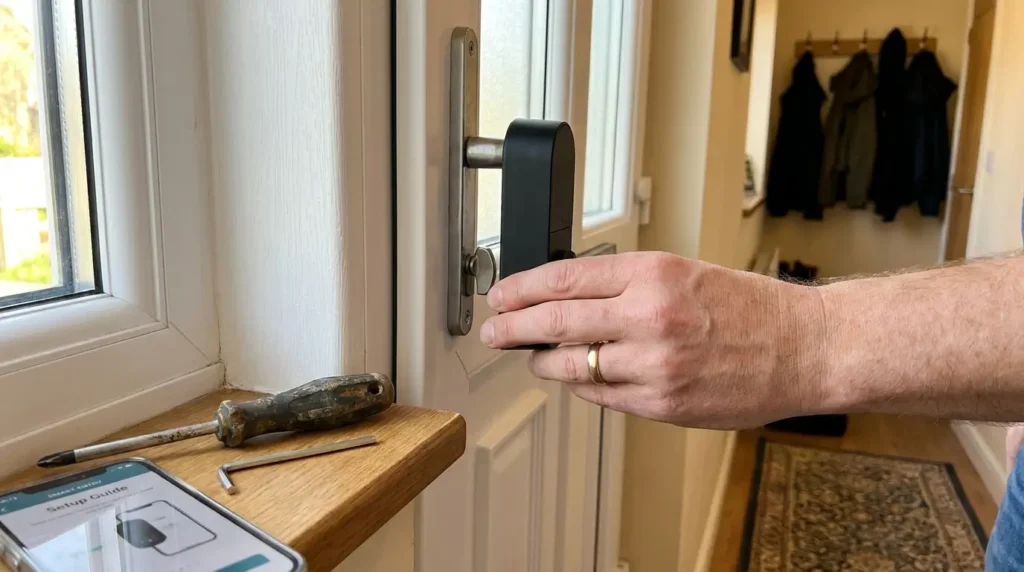
Let’s walk through the real-world process of installing a standard retrofit smart lock onto a British Euro cylinder door.
Step 1: Remove Your Existing Lock (Keep It Safe!)
First, look at the inside face of your door. Use your Phillips screwdriver to back out the screws holding the internal handle plate or thumb-turn mechanism. Gently slide the assembly off the central square metal spindle.
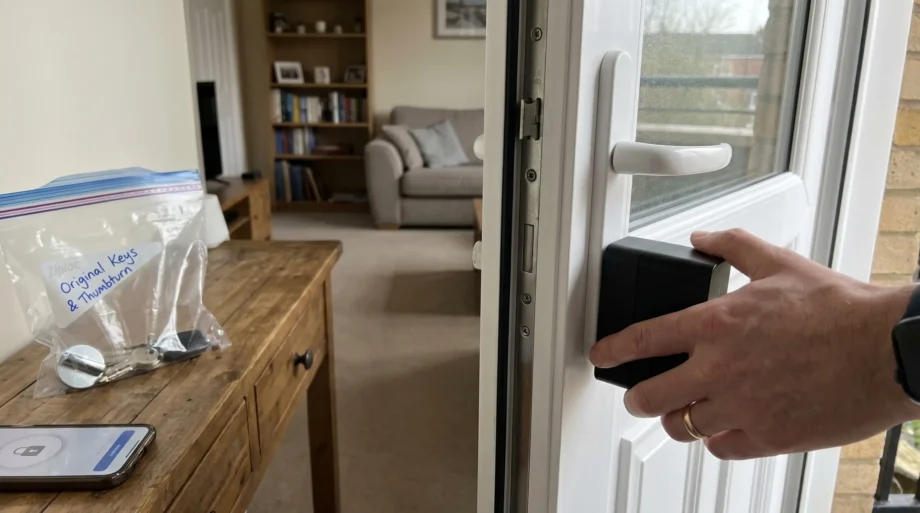
Pro Tip: Grab an empty sandwich bag, put the original screws, plates, and keys inside, and label it. Store it safely in a kitchen cupboard. You will need these parts to restore the door when your tenancy ends.
Step 2: Fit the Mounting Plate or Retrofit Adapter
Take the smart lock’s custom mounting bracket. Line it up over the exposed central spindle. Most premium UK kits will require you to secure this plate using the existing screw holes on the door. Ensure the plate sits perfectly flush against the door surface; if it’s crooked or overtightened, the internal motor will bind, causing your lock to jam up frequently.
Step 3: Install the Smart Lock Mechanism
Now, bring the main motorized chassis of the smart lock to the door. Guide it carefully over the spindle and press it firmly into the mounting bracket until you hear a solid click. Tighten the small securing grub screws on the side or bottom. Hand-tight only—using an impact driver here is a surefire way to crack the internal plastic housing.
Step 4: Download the App and Connect the Lock
Pop the AA or Lithium batteries into the unit. Open up the companion app (such as Simpled or Yale Home) on your phone. Make sure your phone’s Bluetooth is switched on and that you are standing within two meters of the door. Follow the on-screen prompts to pair the hardware, set your master admin passcode, and calibrate the lock’s rotation limits.
Step 5: Test Everything Thoroughly
Do not close your door fully until you have run this test at least three times while standing inside the property:
- Trigger the lock via the app—watch if the motor smoothly turns the deadbolt without straining.
- If your kit has an external keypad, type the code to ensure the latch retracts fully.
- Test the manual override knob from the inside to ensure you have a mechanical way out in an emergency.
- Finally, step outside with your physical backup key and test the external cylinder. Your mechanical key must still turn smoothly. If it feels stiff, the internal adapter is misaligned.
How Much Does It Cost to Install a Door Lock in the UK?
This is naturally the very first question anyone asks before upgrading their home security: how much does it cost to install a door lock in the UK? The honest answer depends entirely on whether you are willing to get your hands slightly dirty or if you’d prefer to hand the hassle over to a professional.
Let’s break down the actual market rates you’ll face in 2026.
DIY Installation — £0
If you decide to handle the fitting yourself, the smart lock installation UK cost drops straight to zero. You are only paying for the retail price of the hardware.
A standard, reliable retrofit smart lock will set you back anywhere between £150 and £250. While premium setups featuring built-in Wi-Fi and biometric fingerprint scanners can push past the £300 mark, the labour itself won’t cost you a penny. To be honest, this is exactly why DIY retrofit kits are the absolute go-to choice for smart UK renters. You save a chunk of cash, get total control over the setup, and ensure no rogue holes are drilled into the frame.
Professional Locksmith Installation — £50 to £150
If the thought of holding a screwdriver makes you break out in a sweat, hiring a local professional is your safest bet. A standard daytime slot for fitting a smart unit generally ranges from £50 to £150, heavily dictated by your UK location (expect London premium rates) and how stubborn your door is.
| Service Type | Average UK Rate | What is Actually Covered? |
| Basic Smart Fitting | £50 – £80 | Standard Euro cylinder setup on a timber door. |
| Multi-Point/uPVC Realignment | £80 – £120 | Heavy-duty handle fitting and latch alignment. |
| Emergency / Out-of-Hours Callout | £120 – £150+ | Evening or weekend emergency fitting. |
Paying this rate guarantees peace of mind. A seasoned pro will instantly spot if your door is misaligned and fix it on the spot. Here’s the catch, though: many traditional British locksmiths are absolute masters at mechanical brass locks but can be surprisingly clueless when it comes to troubleshooting smartphone apps and Bluetooth pairing. Before you book someone, always ask directly if they have hands-on experience with your specific brand.
Premium Brand Installation Services — £100 to £300
Several forward-thinking smart lock brands now offer official “white-glove” installation bundles at checkout. For instance, Simpled UK and Yale frequently offer integrated installation packages where an approved, certified tech handles everything from unboxing to app calibration. While this route is noticeably more expensive than hiring an independent local locksmith, it usually backs the entire setup with an official installation warranty—meaning if the lock jams three months down the line, they come out to fix it completely free of charge.
What Are the Disadvantages of Smart Locks?
Look, I am not here to give you a glossy sales pitch. While keyless entry is incredibly convenient, it is not flawless. After years of testing these gadgets and speaking with local locksmiths, here is the brutal, unfiltered list of the disadvantages of smart locks.
1. Complete Battery Dependence
Smart locks run on standard AA or specialized lithium cells. When those batteries die, the motorized mechanism completely stops working. Now, to be fair, almost every major brand will bombard your phone with low-battery notifications for weeks before it actually gives up. The lock itself will often emit warning beeps every time you leave the house.
But if you are lazy and ignore those warnings, you will get locked out. What makes this worse is the freezing UK winter weather; sustained sub-zero temperatures drastically accelerate battery drain on exterior doors, sometimes cutting expected battery life right in half.
2. The Danger of Having No Manual Override
A massive design flaw in several modern smart locks is the total lack of a physical key slot on the outside. Some models try to fix this by hiding an emergency 9V battery terminal at the bottom of the casing, allowing you to temporarily jump-start a dead lock from the outside. But let’s be real—nobody walks around with a chunky 9V battery in their back pocket. If the internal electronics fry at midnight, you are entirely stuck calling an emergency locksmith.
3. Wi-Fi and Bluetooth Quirks
Wireless tech is inherently prone to occasional glitches. Bluetooth connectivity can sometimes take ages to authenticate when you’re standing in a downpour, and remote Wi-Fi hubs occasionally drop off your home network without warning. While these connection drops rarely leave you permanently locked out (as local Bluetooth or keypads usually still work), they are a massive annoyance when you just want to get inside quickly.
4. Older British Door Incompatibilities
If you live in a charming UK property that hasn’t seen a renovation since the late 1990s, you are likely going to run into compatibility roadblocks. Older timber doors often utilize highly specific oval cylinders or deep-set mortice deadlocks that modern smart hardware simply wasn’t designed to fit. Trying to force a sleek new smart unit onto a warped, 30-year-old wooden frame is an absolute recipe for motor burnout.
Frequently Asked Questions — Smart Lock Installation UK
Can I install a smart lock myself in the UK?
Absolutely. If your door uses a standard Euro cylinder, a retrofit smart lock can be fitted in roughly 10 to 20 minutes using nothing more than a basic screwdriver. Full handle replacements take a bit longer but are still entirely within the realm of basic DIY.
How much does professional smart lock installation cost?
If you hire an independent local locksmith, expect to pay between £50 and £150 for labour. Official brand-approved installation services usually cost between £100 and £300, depending on the complexity of your door.
Will a smart lock invalidate my UK home insurance?
It can if you aren’t careful. Most UK insurers require your main external door lock to meet specific standards (like British Standard BS3621). Always check with your insurance provider to ensure your chosen smart lock model complies with their strict security requirements.
What happens if the smart lock battery dies completely?
If you bought a sensible model, you can simply slide open a hidden panel and use a traditional mechanical backup key. If your lock doesn’t have a key override, you will need to hold a 9V battery to the external contacts to give it temporary power, or call a professional.
Final Verdict — Should You DIY or Hire a Professional?
Now that we’ve laid all the cards on the table, the path forward should be incredibly clear:
- Go the DIY Route if: You are renting, your door has a standard, smooth-turning Euro cylinder, and you want to keep your tenancy deposit completely safe. Brands like Simpled or Nuki are practically made for you.
- Hire a Professional Locksmith if: You own your home, your door features a stiff or complex multi-point system that requires serious muscle to lock, or you simply do not trust yourself around tools. Spending £100 for a perfectly aligned, secure installation is well worth the peace of mind.
🌟 Ready to go keyless? Browse the [Top-Rated Smart Locks for UK Homes on Amazon Today]
